Oh, the humanity.
Like many schools, we've made our humanities curriculum - not topic! - a priority this year. Not just for Ofsted, but because we'd had the curriculum planned for a while and we had puts things in place, it still wasn't getting the time and attention it needed to really come alive and be properly great. It's been the basis of many staff meetings recently, the phase leaders (including myself) have been sent to either geography or history conferences, and our humanities lessons are getting a lot a lot more scrutiny than before. (By a lot more, I mean there was very little if any before and there is some now - nothing horrendous!) We're still working on it but I thought I'd share some of what I've done so far this year, in case it's useful to anyone else.
Timeline
Our head makes the things she doesn't like very clear, and timelines from a well-known resource company (think Heather) is one of them. She has a point. I've 'done' those timeline lessons before and I can honestly say that the dates didn't even stick with me. How I can expect the children to have an idea of the context, duration and chronology with this activity when it didn't work on me? Searching through the Historical Association site, I found an article about a 'Potty timeline' by Alison Mansell and gave it a go.
We started with a laminated piece of toilet tissue. I told the children that it represented one century.
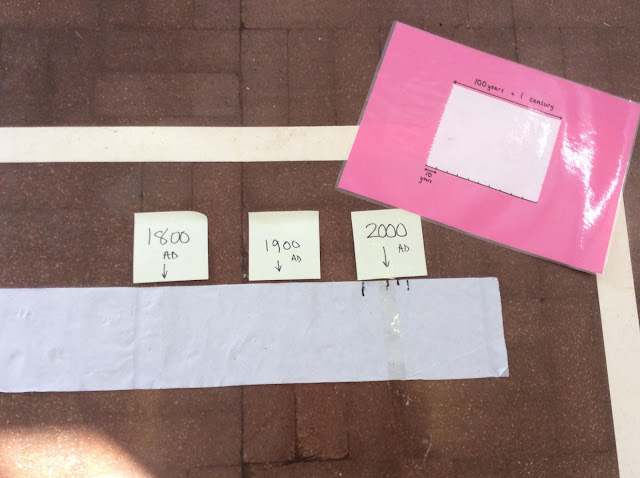
I rolled a roll of tissue out down the length of the hall and labelled the last 200 years. We discussed where the year of their birth would be and all of the things which had happened or been invented in just this short period of time, being particularly shocked when I said that the internet didn't even exist when I was born. (My computer club at school was building a Ceefax page but I didn't tell them that part.)
I then put them in small groups, gave them a historical era and a roll of toilet tissue and set them off to work, their task being to read the information and figure out how many centuries (pieces of tissue) their era needed, and then to place it in the correct place on the 'main' timeline that ran the length of the hall.
I had produced the fact sheets about the different periods of history using Adobe Spark, one of my very favourite tools.


Some of them struggled with the maths aspect (Year 4 and relatively new to negative numbers) but they worked well and were really engaged. They were surprised at first when placing their 'era' sheets down and there was already one in its place, but one thing I really wanted them to understand was that many of these eras overlapped and were happening in different parts of the world at the same time. They could also appreciate how long or short the different eras lasted in relation to each other, with the Stone Age almost completing a full circuit of the hall being the biggest surprise. It's something I'll constantly go back to throughout the year, whenever new eras are discussed, or to go over previous ones covered. My only regret is that we ran out of time. We could have easily spent another hour really looking at what we'd produced in a lot more detail (assembly, lunch and PE got in the way).


Key Questions
Last summer, which seems like about 3 years ago now, I read up on humanities pedagogy, knowing that it was going to be a priority when we went back. I feel really awful for not remembering or writing down the name of the book so I can credit the author, but one thing I used from one of the books were these questions relating to history learning:
Who went where?
Why there?
Why care?
These questions really helped me focus on the main outcomes I wanted for the children. I wanted them to remember when the Romans successfully invaded Britain, why they chose Britain, and the impact the invasion had. With the Romans being such an enormous topic, it made me focus on choosing which aspects to do and which ones not to (mosaics and baths, for example).
These were on my working wall throughout the topic although I didn't really utilise them until the end. When we had reached the end of our block, I went through the questions with them and it was a fantastic way to assess them. Not all could remember the dates but all could give at least one reason why they came and why it mattered.
I'm now trying to think of a geography equivalent, one idea being 'What is where? Why there? Why care?' but I'm open to suggestions! I'm also going to make sure in future that I refer to them throughout the unit, instead of just at the beginning and at the end, to remind the children what questions we should always have in the back of our minds.
Assessment
I wanted a way of assessing what the children had learnt throughout the unit (that word isn't any nicer than topic really). I have produced A4 sheets for the children to complete before, such as the one below.

However, this didn't seem enough. In fact, I'm quite surprised and disappointed in myself that I used to use that! For our Romans learning, I wanted something more substantial and will now always want something more. I produced this on PowerPoint (it's so much easier to manipulate than Word and don't get me started on Publisher) and printed it on A3:

The children loved having the opportunity to show what they knew and understood, and we're now going to use these in our humanities learning across the school. Some year groups are going to fill in sections as they go, as a reference tool for any final pieces of work. Others are going to use them as a way to recall previous learning. I think I'm going to use it the same way as before but I'm likely to change my mind.
Final points
The work we've been doing on the curriculum has been really exciting, and I'm enjoying becoming more confident and have a better understanding of what each of the two subjects entails, though I have a way to go still. Lifelong learner and all that. The main things which have stuck with me though, mostly from the conference I attended, are below. They keep me focused in my planning and are a constant reminder of what I need to do to do the subjects justice. They may seem blindingly obvious but they may not. They're little humanities mantras. Humantras, maybe.
Timeline
Our head makes the things she doesn't like very clear, and timelines from a well-known resource company (think Heather) is one of them. She has a point. I've 'done' those timeline lessons before and I can honestly say that the dates didn't even stick with me. How I can expect the children to have an idea of the context, duration and chronology with this activity when it didn't work on me? Searching through the Historical Association site, I found an article about a 'Potty timeline' by Alison Mansell and gave it a go.
We started with a laminated piece of toilet tissue. I told the children that it represented one century.

I rolled a roll of tissue out down the length of the hall and labelled the last 200 years. We discussed where the year of their birth would be and all of the things which had happened or been invented in just this short period of time, being particularly shocked when I said that the internet didn't even exist when I was born. (My computer club at school was building a Ceefax page but I didn't tell them that part.)
I then put them in small groups, gave them a historical era and a roll of toilet tissue and set them off to work, their task being to read the information and figure out how many centuries (pieces of tissue) their era needed, and then to place it in the correct place on the 'main' timeline that ran the length of the hall.
I had produced the fact sheets about the different periods of history using Adobe Spark, one of my very favourite tools.


Some of them struggled with the maths aspect (Year 4 and relatively new to negative numbers) but they worked well and were really engaged. They were surprised at first when placing their 'era' sheets down and there was already one in its place, but one thing I really wanted them to understand was that many of these eras overlapped and were happening in different parts of the world at the same time. They could also appreciate how long or short the different eras lasted in relation to each other, with the Stone Age almost completing a full circuit of the hall being the biggest surprise. It's something I'll constantly go back to throughout the year, whenever new eras are discussed, or to go over previous ones covered. My only regret is that we ran out of time. We could have easily spent another hour really looking at what we'd produced in a lot more detail (assembly, lunch and PE got in the way).


Key Questions
Last summer, which seems like about 3 years ago now, I read up on humanities pedagogy, knowing that it was going to be a priority when we went back. I feel really awful for not remembering or writing down the name of the book so I can credit the author, but one thing I used from one of the books were these questions relating to history learning:
Who went where?
Why there?
Why care?
These questions really helped me focus on the main outcomes I wanted for the children. I wanted them to remember when the Romans successfully invaded Britain, why they chose Britain, and the impact the invasion had. With the Romans being such an enormous topic, it made me focus on choosing which aspects to do and which ones not to (mosaics and baths, for example).
These were on my working wall throughout the topic although I didn't really utilise them until the end. When we had reached the end of our block, I went through the questions with them and it was a fantastic way to assess them. Not all could remember the dates but all could give at least one reason why they came and why it mattered.
I'm now trying to think of a geography equivalent, one idea being 'What is where? Why there? Why care?' but I'm open to suggestions! I'm also going to make sure in future that I refer to them throughout the unit, instead of just at the beginning and at the end, to remind the children what questions we should always have in the back of our minds.
Assessment
I wanted a way of assessing what the children had learnt throughout the unit (that word isn't any nicer than topic really). I have produced A4 sheets for the children to complete before, such as the one below.

However, this didn't seem enough. In fact, I'm quite surprised and disappointed in myself that I used to use that! For our Romans learning, I wanted something more substantial and will now always want something more. I produced this on PowerPoint (it's so much easier to manipulate than Word and don't get me started on Publisher) and printed it on A3:

The children loved having the opportunity to show what they knew and understood, and we're now going to use these in our humanities learning across the school. Some year groups are going to fill in sections as they go, as a reference tool for any final pieces of work. Others are going to use them as a way to recall previous learning. I think I'm going to use it the same way as before but I'm likely to change my mind.
Final points
The work we've been doing on the curriculum has been really exciting, and I'm enjoying becoming more confident and have a better understanding of what each of the two subjects entails, though I have a way to go still. Lifelong learner and all that. The main things which have stuck with me though, mostly from the conference I attended, are below. They keep me focused in my planning and are a constant reminder of what I need to do to do the subjects justice. They may seem blindingly obvious but they may not. They're little humanities mantras. Humantras, maybe.
- Knowledge rich does not mean content heavy
- Children need to know more but also understand the significance of what they know
(My main focus for next year. What can you do with that knowledge? How does knowing it change you?) - Feedback on subjects should not be literacy based but subject based! Comments, verbal or written, should be about the geography or history skills, not handwriting, paragraphing or any other literacy skill/device.
- Make the lessons explicit. "Today, in our Space Race work, we're going to be working as historians/geographers/scientists." I definitely have not done this enough in the past.
Hopefully, some of this may help someone. If not, it's helped me reflect at least. x
PS. If you use 'humantra', I want full credit for creating it. Unless it's not as clever as I think it is and then I'll deny all knowledge.

Comments
Post a Comment